
Nobody checks
I need to tell you what actually happened with hoodscout, because it’s the reason for everything I do next, and because I’ve been sitting on it for a week trying to find a version that’s softer than the truth. There isn’t one. So here’s the truth.
the tool
The last launch of the run was the best product I’ve ever shipped. It was called hoodscout, and it went live on Robinhood Chain on July 16th at 22:42 UTC. What it did: it watched every single token launch on that chain in real time and read the wallets behind each one. Bundles. Funding clusters. Fake crowds. Volume-bot patterns. The stuff that’s technically all sitting right there on the public ledger, but that nobody actually stops to read while a chart is moving. Hoodscout read it for you, live, as it happened.
And it worked. Day one, it caught a token seeding 199 fresh holders from a single wallet in a single transaction. One wallet, one second, 199 “holders” appear out of nothing. Then it happened again. Six times in an hour, roughly every twelve minutes, the same manufactured crowd getting stamped out and rebuilt. Hoodscout flagged every drop as it landed. It did exactly what I built it to do. It made an invisible manipulation visible in real time, to anyone watching.
The tool is not the story. I want to be clear about that, because a lesser version of this essay is just me being proud of the tool. The tool worked perfectly. That’s the setup, not the point.
Here’s the part I didn’t say at the time.
the reveal
The token the tool ran on, $HS, was bundled too. By me. On purpose.
The cluster sat on every bubble map from the first minute. Red circles, connected wallets, the exact pattern the tool one tab over was built to expose. Top ten wallets held about 26 percent of supply. If you had opened any standard bubble-map viewer and looked at the token attached to the bundle detector, you would have seen the bundle. It was not hidden. It was not subtle. It was the loudest thing on the chart.
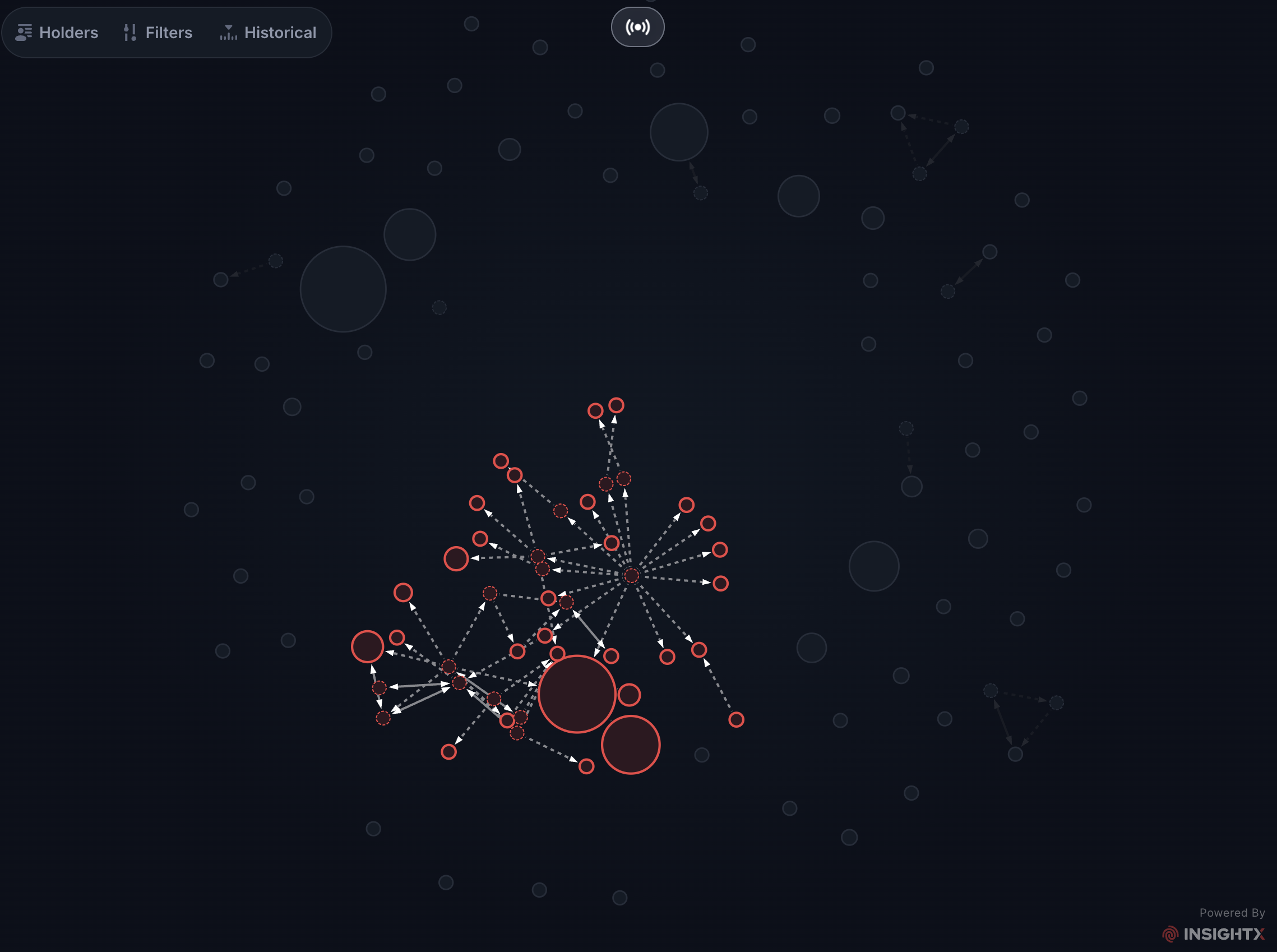
206 people bought it.
Not one of them mentioned the map.
Not in the replies, not in the chat, not in a DM, not anywhere I could find. 206 people bought a bundle-detection tool whose own token was bundled in plain sight, and the number of them who noticed, or at least the number who said anything, was zero. I sold a microscope to a crowd and pointed it directly at the crime, and nobody looked through the lens.
The token hit about $58,000 in market cap at its peak, roughly ten and a half hours in. 206 holders. The launch thread did 1,543 views and 13 likes. Eighteen hours after the peak, silence. Dead in under a day, same as the worst launch of the run, which is its own lesson and not this one.
This one is simpler. I ran the exact test the tool was built to help people run, on the tool itself, and the answer came back clean and unanimous.
Does anyone actually check?
No. Nobody checks. Narrative beats diligence every single time, and it doesn’t beat it narrowly, it beats it 206 to nothing. Attention is the only diligence left, because it’s the only one anyone actually performs.
The experiment harmed no one financially: the bundle was closed after distribution at no profit, the receipts are on chain, and every campaign I run from here forward is disclosed. That line is not optional and I’m not going to soften the sentence around it. The point was never to take money. The bundle closed for nothing. The point was the question, and the question got answered.
the seven-launch record
hoodscout wasn’t a fluke result. It was the seventh time I got the same answer, and by then it was just the loudest way of saying what the other six had already said. Here’s the whole run, one line each, every number public:
- I built a 31,000-line agent framework; the token, $SAM, hit a $3.6M peak market cap; I never sold a coin; roughly $137k in creator fees at the time, earned because attention moved, not because I dumped.
- 1.6 million impressions in a single day; 3.07 million views across the launch era; a single tweet at 130,900. The framework barely changed the whole time. What changed was how many eyes were on the story about it.
- $B40 did a 30x on day one, 510 holders, felt like a machine, then died. Autopsy published, on chain.
- When it died, 14 wallets burned their entire remaining position, past a Phantom scam warning, to keep a seat in a room. Loyalty that had nothing to do with the chart.
- I purged 18 members from that room in one pass. Zero complaints. Attention decays faster than resentment forms.
- I shipped a full product on a brand-new chain in 36 hours; the community revived the token on its own, without me pushing it, the one time owned attention actually showed up.
- And I built a bundle detector whose own token was bundled in plain sight, and nobody noticed.
Seven launches. Real tools, real products, real rooms, four chains’ worth of mechanics. The best product died in eighteen hours and so did the worst. The chart never once cared what was real. Not one time across seven attempts did the quality of the thing predict what the market did with it.
At some point that stops being a series of disappointments and starts being a finding. So I stopped fighting the finding. Now I build on it.
the claque
There’s a piece of history I keep coming back to.
In the Paris theaters of the 1820s there was a profession. Organized applause. A man named Sauton opened an office in the city in 1820 that did nothing but supply it, and by 1830 it was a regular institution, filling orders from theater managers for as many as 500 people for a single night. His people were planted through the paying crowd and they had specialized roles. The commissaires memorized the play and turned to their neighbors between acts to point out the good parts. The rieurs laughed at the jokes. The pleureurs, usually women, held handkerchiefs to their eyes and wept on cue. The chatouilleurs, the ticklers, worked to keep the whole room in a good mood. The bisseurs called for encores.
The crowd around them always joined in. The laughter spread, the tears spread, the applause spread, the show became a hit. And the people in the seats never knew the first pair of hands was hired. They didn’t feel manipulated. They felt like they were part of something that was working, which is a much more powerful feeling and a much harder one to argue with.
They were called the claque.
The theaters are mostly gone. The profession never left. It just moved to where the crowds moved, and right now a lot of the crowds are watching charts.
the honest version
Here’s the thesis, said plainly. The market already runs on manufactured attention. The bundles, the seeded holders, the coordinated pushes, the first hands clapping so the rest of the room joins in. That’s not a corruption of how the thing works, that IS how the thing works, and my seven launches proved that nobody is checking whether the applause is real. They’re checking whether it’s loud.
You can respond to that two ways. You can pretend it isn’t true and keep losing to people who know it is. Or you can do the same thing openly, with disclosure, and let people decide with the information in front of them instead of hidden behind them. Covert, it’s a con. Disclosed, it’s a service. The mechanism is identical. The only variable is whether the room is told.
I’d rather be the claque that announces itself.
what comes next
So that’s what I’m building. It’s called claque, after the profession that’s been doing this for two hundred years, and it does the honest version of the thing the market already rewards: engineering attention, in the open, disclosed, with the receipts on chain. That’s all I’ll say about it today. What it is, who it’s for, and how it works is a separate conversation, and I only get one ask a week.
The claque exists. That part is real now.
Every number in this essay is on the board at b40.club/log.
This is what I write about every week. Subscribe if it landed.